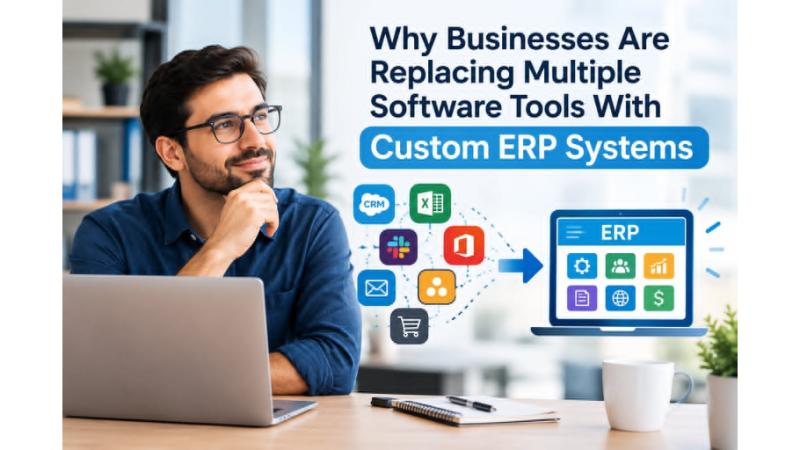
Most businesses don’t have a software problem. They have a visibility problem. Leadership teams across industries are sitting on more operational data than ever—spread across CRM platforms, accounting tools, inventory systems, and HR software — yet they consistently struggle to make fast, confident decisions. The cost of that struggle rarely appears on any invoice. Businesses investing in custom ERP software solutions India are not simply cutting subscription costs. They are solving something far more expensive: the lag between when a business event happens and when the right person knows about it. That lag has a name—decision latency—and it is one of the most damaging operational conditions a scaling business can carry.
The Real Problem Isn’t Too Many Tools—It’s Too Little Visibility
The dominant narrative around multi-tool environments focuses on cost: too many subscriptions, too much overlap, too much waste. That framing misidentifies the problem. The genuine damage is not financial — it is informational.
When operational data is distributed across five or six disconnected platforms, no single view reflects what the business actually looks like right now. Finance sees last week’s numbers. Sales is working from yesterday’s pipeline. Inventory reflects a sync that completed three hours ago. Each tool is functioning as designed. The problem is that no tool is responsible for synthesising across all of them.
Decision latency is the measurable gap between a business event occurring and a decision-maker receiving a clear, actionable signal from it. Research consistently shows that senior leaders spend a disproportionate share of their working week locating data, reconciling conflicting reports, or simply waiting — before they can act. That is not an efficiency problem. It is a judgment problem. Fragmented software stacks don’t just slow workflows. They slow the thinking that drives the business forward.
How Fragmented Software Stacks Create an Information Lag Problem
Each disconnected tool captures a narrow slice of operational reality. None synthesise across those slices in real time. When a leadership decision requires cross-referencing sales performance, current inventory levels, cash position, and headcount — which most strategic decisions do — assembling that picture is entirely manual. The data exists. Accessing it coherently does not.
The “we have integrations” objection comes up often. It does not hold. API connections and middleware platforms transfer data between systems, but they do not provide continuous synchronisation. They schedule it. A Zapier workflow or a Make automation fires when triggered — not when the business needs it. Even well-integrated tool stacks deliver information that is, at minimum, hours old by the time it reaches decision-makers.
Automation tools are marketed as real-time bridges. They are not. They are transfer mechanisms operating on a delay. In slow-moving environments, that delay is inconvenient. In competitive, high-volume markets, it is a structural disadvantage that compounds across every decision cycle.
Where Latency Hides in Day-to-Day Operations
The most damaging aspect of decision latency is that it becomes invisible. Teams adapt to it. A weekly sales review is prepared using data that is already 48 to 72 hours stale. A procurement decision is made without current inventory visibility because the inventory system updates overnight. HR bottlenecks accumulate because payroll and attendance data live in separate platforms that reconcile once a month.
None of these gaps feel catastrophic in isolation. Cumulatively, they establish a slower decision rhythm across the entire organisation — one that leadership rarely traces back to its structural cause.
Why Replacing Tools Alone Does Not Solve the Problem
Switching platforms is not a structural fix. It is a substitution. A business that replaces its CRM or accounting software with a more capable version has changed the quality of one data silo. It has not changed the architecture that creates latency.
The root condition is not the inadequacy of any individual tool. It is the fact that operational data lives in separate environments, updated on separate cycles, managed by separate teams. Custom ERP software development services solve a different problem than tool replacement does. They eliminate the need for separate data environments entirely — not by connecting existing tools, but by removing the structural conditions that make latency inevitable.
Businesses that have gone through one or two rounds of platform migration without resolving their visibility problem are not making poor technology choices. They are applying a tool-level solution to an architecture-level problem.
How Custom ERP Eliminates Decision Latency at the Architecture Level
A custom ERP system does not bridge tools. It replaces the reason those tools need bridging. Every operational function — sales, inventory, finance, HR, procurement — operates within a single, shared data environment. When a sale is logged, inventory updates. When inventory drops below threshold, procurement is notified. Finance reflects the transaction in real time. No sync required. No transfer delay.
Leadership is not waiting for a report to generate or a scheduled export to complete. The current state of the business is structurally visible at all times. Custom ERP software solutions India built on this principle give organisations something no integration stack can replicate: a single version of operational truth, updated continuously.
The emphasis on “custom” is not incidental. Off-the-shelf ERP systems impose a generic process model designed for a hypothetical average business. Custom ERP is architected around the organisation’s actual decision-making logic — structured the way leadership interrogates the business, not the way a vendor assumed they would.
The competitive advantage this produces is not efficiency. Efficiency is a downstream effect. The primary gain is the speed and confidence of judgment. Businesses that make better decisions faster than their competitors don’t achieve that through harder work. They achieve it through better information architecture.
What This Looks Like in Practice for a Scaling Business
Fragmented tool environments scale badly. Every new function, market, or product line adds another tool, another integration point, another lag source. Complexity multiplies linearly — and so does latency.
A business running on a custom ERP absorbs that complexity differently. New functions are added to a shared environment, not bolted onto a widening stack. A business processing high daily volumes across sales, inventory, and finance can make same-day strategic pivots because all three functions draw from the same data layer simultaneously. Custom ERP software development services built to match the organisation’s scale trajectory ensure that growth adds operational capacity — not operational drag.
The Decision to Replace Tools Is a Strategic One, Not a Technical One
This conversation does not belong in an IT meeting. It belongs in the room where leadership decides how fast the business can move and how clearly it can see. ERP adoption is an investment in the quality and speed of executive judgment — not a system upgrade.
The stakeholders who should own this decision are operations leads, finance directors, and C-suite — not just IT. The first question is not “which ERP platform?” The right question is: where is our decision latency worst, and what is it costing us in missed opportunities, delayed pivots, and slow responses? Businesses working with providers of top custom ERP software solutions India are starting from that question — and finding that the answer changes how they think about growth entirely.
Partner With Arobit to Eliminate Decision Latency for Good
Slow decisions are rarely a people problem. They are an architecture problem. When operational data is fragmented across disconnected tools, leadership loses the one thing that drives competitive performance: the ability to see clearly and act fast.
Arobit builds custom ERP software solutions India businesses rely on to replace fragmented tool stacks with a single, unified operational environment. Every solution is architected around your actual business logic — not a vendor’s generic workflow template. The result is real-time visibility across every function, faster executive judgment, and a data infrastructure that scales without multiplying lag.
If your leadership team is spending more time assembling information than acting on it, the cost is already compounding. Arobit’s custom ERP software development services are designed to close that gap at the architecture level — so your business stops reacting and starts leading.
Frequently Asked Questions
- What exactly is decision latency, and how does it differ from operational inefficiency?
Operational inefficiency refers to slow processes within a function — delayed approvals, manual data entry, redundant steps. Decision latency sits above that. It is the gap between when a business event occurs and when a decision-maker receives a clear, reliable signal from it. A business can have highly efficient individual teams and still suffer severe decision latency if those teams report from disconnected data environments. The two conditions require different fixes.
- Can advanced integrations between existing tools eliminate decision latency without a full ERP migration?
Not structurally. Integration tools — API connectors, middleware platforms, or automation workflows — transfer data on a trigger or schedule. They do not create a shared, continuously updated data environment. The lag is reduced in some cases, but the architectural fragmentation remains. ERP eliminates the architecture that produces the lag. Integrations only manage it.
- How does a custom ERP reduce decision latency compared to an off-the-shelf ERP platform?
Off-the-shelf ERP systems impose a standardised process model built around a vendor’s assumptions. When your decision-making logic differs from that model — which it almost always does — leadership still works around the system to get the information it needs. A custom ERP is built around your specific reporting hierarchies, operational triggers, and data relationships. Visibility is immediate because the system reflects how your leadership actually runs the business.
- At what stage of growth should a business evaluate replacing its tool stack with a custom ERP?
The right trigger is not headcount or revenue — it is decision quality. When leadership is consistently doing decisions based on data that is already hours, or days old , when cross functional reporting turns into a heavy manual reconciliation thing, or when every new business function brings yet another integration dependency to babysit, the tool stack has kind of hit its architectural ceiling. The signs are pretty consistent: slower pivots, less confidence in the reported numbers, and more time spent shepherding data instead of acting on it.